The Vietnamese lunar calendar: why leap months and date differences occur
Basic concepts for understanding the lunisolar calendar and looking up dates more carefully.

The familiar “lunar calendar” is actually lunisolar
In everyday life, we often say “lunar date” to distinguish it from the Gregorian date on a work calendar. Vietnam’s traditional calendar is lunisolar: months follow the Moon’s cycle, while the arrangement of years also accounts for the Sun’s cycle. Because the two cycles do not align in a whole number of months, the calendar needs adjustment rules.
This explains why a lunar festival falls on different Gregorian dates in different years. You cannot take last year’s Gregorian date and add a fixed number of days to find next year’s festival. When recording an event, keep its original lunar date and the necessary details, then look up the corresponding Gregorian date for each year.
From new moon to new moon
- New moon
- First quarter
- Full moon
- Last quarter
- New moon
One phase cycle ≈ 29.53 days
The phases occur because we see different portions of the half of the Moon illuminated by the Sun.
A leap month adds a month, not a day
Lunar months usually have 29 or 30 days. A year of 12 lunar months is shorter than the solar year; adding a leap month in certain years keeps the calendar aligned with the seasons. A leap month repeats a month’s name, so an ordinary month and a leap month can have the same number in one year. They are separate periods.
Writing “the 10th day of the 4th month” may therefore be insufficient in a year with a leap 4th month. You need to know which month is meant. Do not infer leap months from a simple cycle or assume every lunar month has 30 days. For important dates, use a calendar that clearly marks leap months and check the reverse conversion back to the original date.
Why does the calendar need leap months?
Difference ≈ 10.87 days
Adding a month in years determined by the calendar rules helps correct the accumulated difference.
Time zones are part of calendar calculation
An astronomical event occurs at one instant but can fall on different civil dates in two time zones. Near midnight, that difference may affect which day is identified as the start of a month under the calendar’s rules. Two tools using different time zones will therefore not necessarily give the same date in every case.
When looking up the Vietnamese calendar, check that the tool uses the appropriate Vietnamese convention, usually UTC+7 for the current calendar. Historical dates also require attention to the source’s supported years and conventions. A modern app does not automatically verify every date in the past. Keeping original documents or date sources makes comparisons better grounded.
A process for checking dates without confusion
Record the full day, month, year and calendar type before converting. For a lunar date, check the leap-month flag. After finding the Gregorian date, convert it back to confirm a match. For annual memorial anniversaries, separate date conversion from family conventions for leap months or months without a 30th day. Software can provide reminders, but it cannot decide your customs for you.
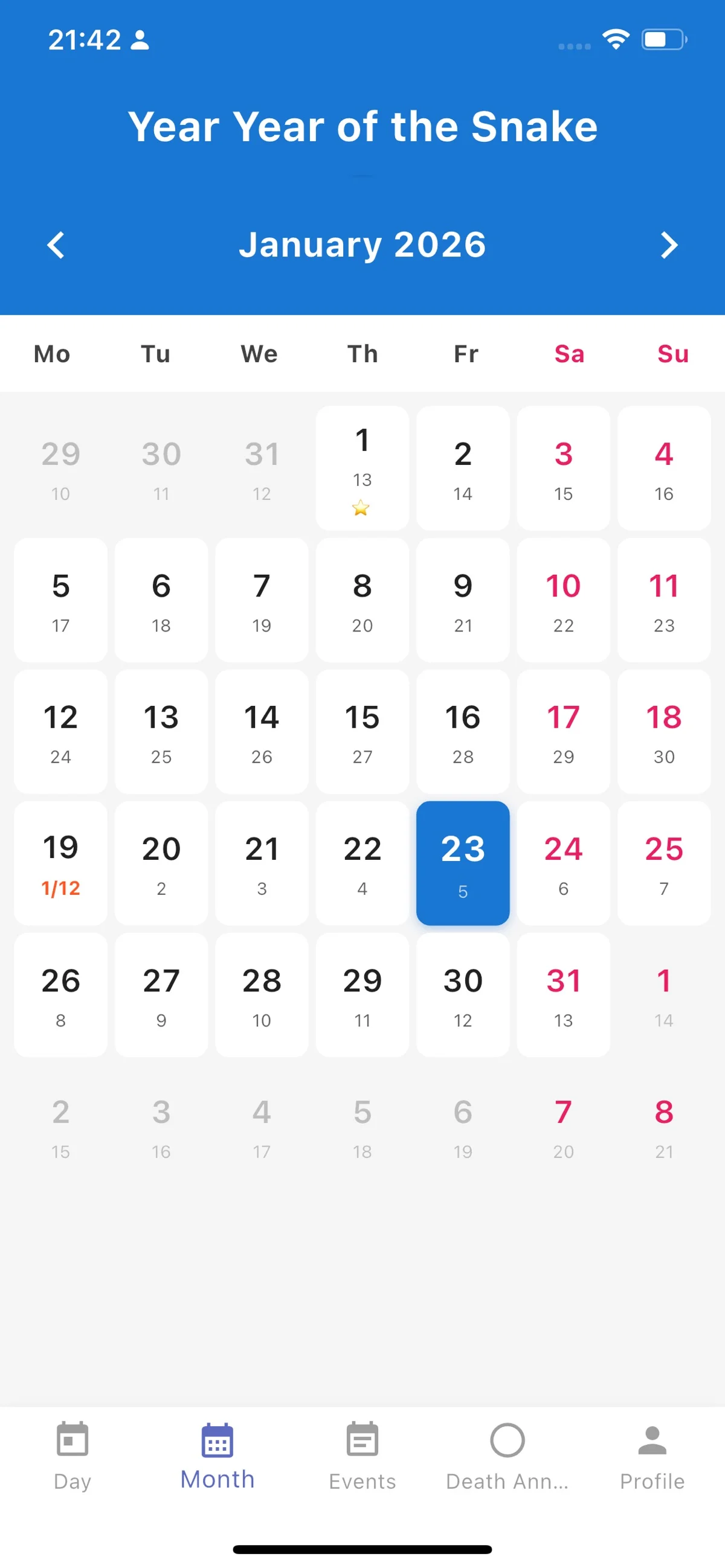
MyLunar is MWRKS’s tool for viewing the calendar and organizing important dates. Check event details before enabling annual reminders. Also distinguish calendar information from cultural references such as auspicious days or hours: date calculations are not evidence that a particular time determines the outcome of an activity.
Compare lunar and Gregorian dates
References
- Hong Kong Observatory — Principles of the lunisolar calendar ↗
Source for month cycles and why leap months are needed. The Hong Kong calendar is not a substitute for looking up Vietnamese calendar dates.
MyLunar (Lunar Calendar & Reminders)
Remember important dates, preserve family stories
Look up lunar and Gregorian dates, track memorial anniversaries and record your family tree. Keep important milestones together for easy reference.
Frequently asked questions
Is there a leap month every three years?
Do not use that rule of thumb to look up a particular date. Leap years and leap months are determined by lunisolar calendar rules, rather than adding the same month every three years. Check the actual year you need.
Why does the 15th lunar day not always match the exact full moon?
The 15th day is a calendar date within a lunar month. The full moon is an astronomical instant. One is a civil-date label and the other the timing of a phenomenon, so they should not be treated as identical.
Related articles

Recording family trees and memorial dates: start with reliable information
Preserving family memories involves more than entering names in a family tree. Record sources, clarify dates, ask permission to share and check your backups.

Teaching mental arithmetic: understand the method before building speed
From addition across ten to multiplication tables, help children explain their thinking. Speed should follow understanding and accuracy.

Gamifying math practice: what should rewards support?
Points, coins and collectible cards can spark interest, but should connect to a clear learning goal. A framework for parents observing a math practice app.